Cart
0
You may also like


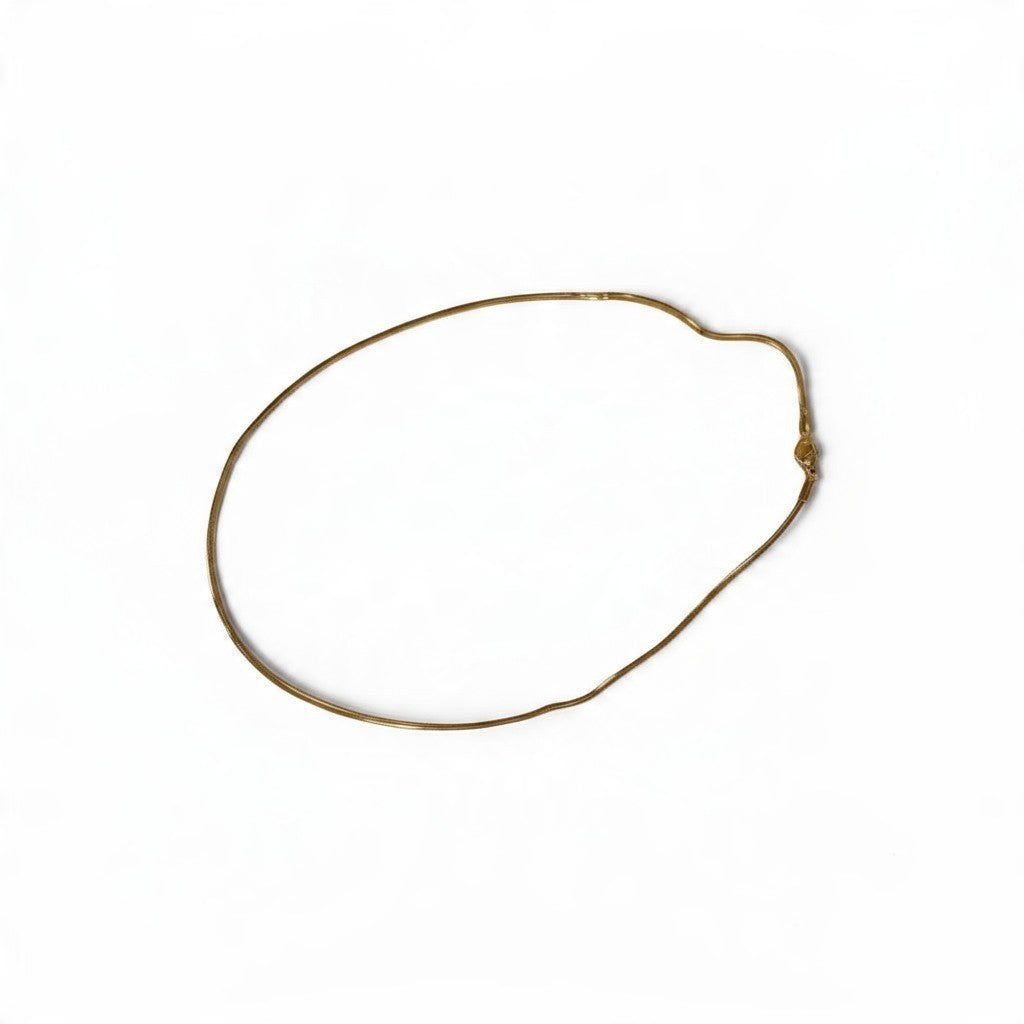


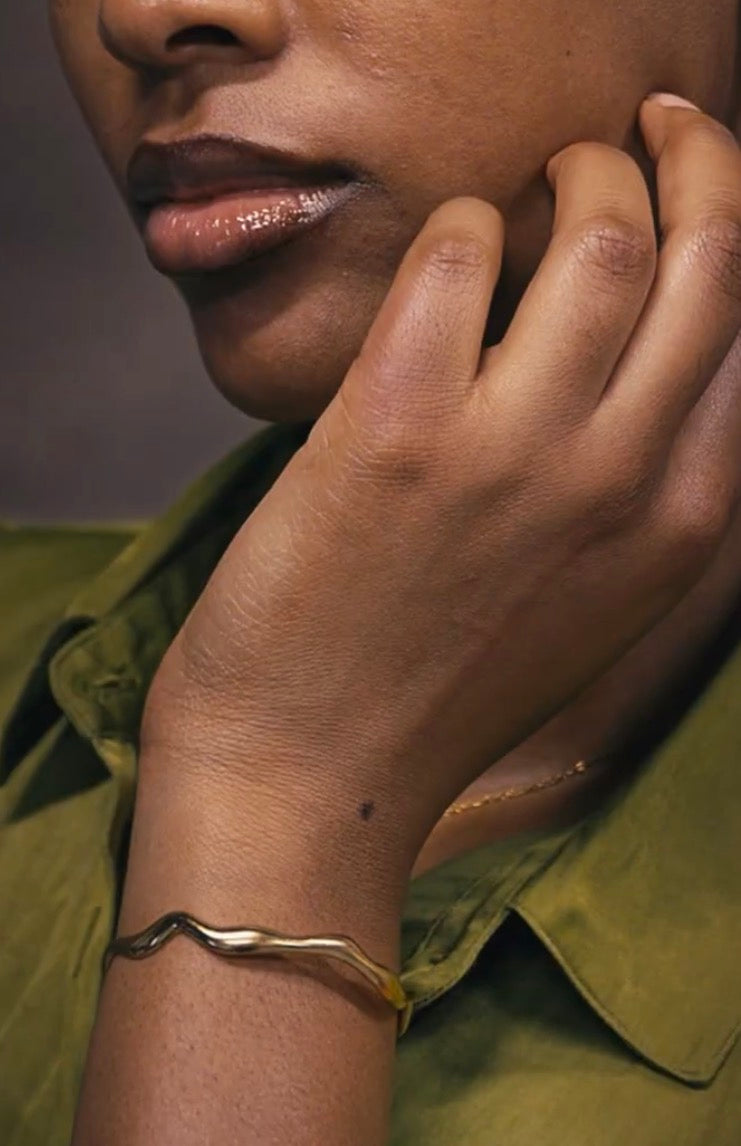
If your gold-plated jewelry has ever turned your skin green, you're not alone — and it's not a coincidence. The green ring around your wrist is chemistry, not bad luck. And once you understand what causes it, you'll understand something far more useful: how to read a product listing, spot quality before you buy, and stop replacing jewelry that was never built to last.
The green stain has almost nothing to do with the gold you can see on the surface. It has everything to do with what's underneath it — the base metal that most brands don't want to discuss, and that most buyers never think to ask about.
You may have worn a piece for six months before the stain appeared. Or you noticed it after a workout, a warm day, or a weekend away. What you were seeing wasn't wear and tear. It was the base metal reacting to your skin chemistry — specifically to the acids in your sweat — and that reaction tells you more about a piece's quality than the karat number, the packaging, or the price.
This is the guide that product listings skip.
The chemistry is simpler than it sounds — and knowing it changes how you shop.
Most gold-plated jewelry is built on a copper or brass base metal. Copper is reactive. When it comes into contact with the natural acids present in sweat and the oxygen in the air, it undergoes oxidation, producing compounds that transfer onto the skin as a blue-green residue. You may know this process from old copper coins, or from the Statue of Liberty's iconic green patina — the same chemical reaction on a different scale.
Brass, one of the most common base metals used in mid-range gold-plated jewelry, is an alloy composed of roughly 70% copper and 30% zinc, according to Hope Jewellery. Because of its high copper content, it carries the same oxidation risk as pure copper, though slightly slower. The more you sweat, move, or expose the piece to warmth and humidity, the faster the reaction.
Here is the critical part that most guides don't make clear: the gold plating on top does not permanently prevent this reaction. Gold plating wears down over time through friction, moisture, and daily contact — exposing the base metal beneath. Even before the plating visibly wears, the base metal's chemistry affects how the whole piece performs: how it interacts with your skin, how long the plating holds, and what happens on the days when life asks more of your jewelry than a gentle afternoon.
The gold is the finish. The base metal is the foundation. The finish only holds if the foundation can support it.
Here is how the three most common base metals in gold-plated jewelry actually compare — and why the difference is significant.
The most reactive base metal. When copper oxidizes in contact with sweat and air, it produces blue-green compounds that transfer directly onto skin. Typical lifespan before significant tarnishing or discolouration: 6–12 months, according to Hope Jewellery's comparison of base metal performance. Copper cannot be worn in water without accelerating degradation.
The most widely used base metal in fashion and mid-range jewelry. Brass contains approximately 70% copper, which means it carries most of copper's oxidation risk at a slightly slower rate. Typical lifespan under regular wear: 1–2 years. Prone to tarnishing in humid conditions. Not recommended for water exposure or sensitive skin.
The strongest-performing base metal for gold-plated jewelry. Stainless steel contains chromium, which forms a self-renewing oxide layer on the surface — a passive, corrosion-resistant shield that remains stable even in the warm, moist environment of daily skin contact. Meideyajewelry notes that the 316L grade meets the ASTM F138 standard — the biocompatibility specification used for surgical-grade implants — because of its very low rate of metal ion release. Typical lifespan under regular wear: 5+ years, according to Hope Jewellery — more than double the lifespan of brass and approximately five times that of copper. Genuinely waterproof. Tarnish-resistant. Appropriate for most skin sensitivities.
At a glance:
|
Base Metal |
Typical Lifespan |
Skin Reaction Risk |
Water Resistant? |
Tarnish Risk
|
|---|---|---|---|---|
|
Copper |
6–12 months |
High |
No |
Very High |
|
Brass |
1–2 years |
Moderate–High |
No |
High |
|
316L Stainless Steel |
5+ years |
Very Low |
Yes |
Low |
Lifespan estimates based on regular daily wear. Source: Hope Jewellery.
Two pieces can look identical in a photograph and be built on entirely different foundations. That gap in longevity — six months versus five or more years — is not a small difference. It is the difference between a jewelry collection and a recurring expense.
You will see "18K gold plated" on many product listings. Here is a precise reading of what that phrase means and, importantly, what it leaves out.
The "18K" refers to the purity of the gold used in the plating layer. 18 karat gold contains 75% pure gold, according to Jewelry Informer. The remaining 25% is alloyed with other metals to improve workability. A 14K gold plating contains 58% pure gold — giving a slightly cooler, lighter gold tone. The higher the karat, the warmer and more saturated the colour, and generally the more resistant the plating to tarnishing.
What "18K" does not tell you: how thick that plating layer is.
Thickness is measured in microns, and it matters. Quick Jewelry Repairs identifies two distinct quality tiers across the industry:
Flash plating: Under 0.175 microns — applied quickly, fades quickly, not designed for sustained daily wear
Quality plating: 1 micron and above — a substantially thicker layer, more resistant to daily friction and wear
A piece can carry the label "18K gold plated" whether it is flash-plated or quality-plated. Knowing to ask the question — and knowing what a real answer sounds like — is part of what separates an informed buyer from one who replaces jewelry every season.
These are the questions that turn a product listing from opaque to legible.
1. What is the base metal?
Look for "316L stainless steel" in the product description. If the base metal is not named, that omission is itself a signal. Brands confident in their materials name them.
2. What karat is the plating?
18K is the standard for a warm, rich gold tone with good longevity. Anything below 14K may appear lighter and is likely to show wear faster.
3. How is the piece plated — flash or quality?
Some brands describe their jewelry as "built for daily wear" or "designed to last" — these phrases suggest quality plating rather than flash. The most direct approach is to ask the brand directly. How a company responds to a specific material question tells you something about how it operates.
4. Does the brand provide specific care guidance?
Detailed care instructions — store pieces separately, avoid direct perfume contact, keep away from chlorine, remove before swimming — signal a brand that understands its product and is invested in the outcome for you. Vague or absent care guidance is a different kind of message.
CJ's jewelry is built on 18K gold plating over a stainless steel base — the most durable combination for pieces designed to be worn daily, in the real spaces of your life, without requiring constant attention or replacement.
Even with the best base metal and quality plating, how you store and wear your jewelry has a direct impact on how long it lasts. These are the practices that make the most difference.
Store pieces individually. Stacking jewelry in a drawer or box allows pieces to scratch each other and accelerates surface wear. Individual pouches or compartments protect the plating and reduce friction between pieces.
Remove before contact with water, chemicals, and perfume. Chlorinated water from swimming pools, cleaning products, and even the alcohol-based compounds in fragrance can break down plating over time. A useful rule: jewelry goes on last, and comes off first.
Clean gently and regularly. A soft, lint-free cloth after wearing removes sweat and skin oils before they can build up and react with the plating. Avoid harsh cleaning solutions or abrasive cloths — they strip the plating surface faster than almost anything else.
Remove during physical activity. High-intensity exercise increases sweat exposure and friction — both accelerate the conditions that shorten a piece's lifespan. Removing jewelry before a workout extends it measurably.
Read the brand's care guide. The brand made the piece; their specific guidance for their materials supersedes general advice. Its existence — or absence — tells you something about how seriously they take the quality of what you bought.
For more on what affects longevity across different gold-plated materials, see our earlier guide on how long gold-plated jewelry really lasts.
Will gold plated jewelry always eventually turn my skin green?
Not necessarily. The green stain is produced by oxidation of copper and brass bases — metals that react with sweat and air. Jewelry built on a 316L stainless steel base does not undergo the same reaction. If you've consistently experienced green staining from gold-plated pieces, the base metal is most likely the cause — not gold plating as a category.
Is gold-plated jewelry worth buying in 2026?
Yes — with the right specifications. Gold-plated jewelry at the right quality tier (18K plating, 316L stainless steel base, quality plating rather than flash plating) is durable, versatile, and built for daily life. The global luxury jewelry market reached USD 75.79 billion in 2026, according to Next MSC, with growth driven in part by consumers prioritising quality pieces over disposable fashion. The real question isn't "plated or not" — it's "which plating, on what base, built to what standard?"
Can I seal my jewelry to stop it turning my skin green?
Clear nail varnish applied to the inner surface of a piece creates a temporary barrier between the metal and your skin. This is a workaround, not a solution — it wears off and needs reapplication. The durable approach is to choose non-reactive base metals from the start.
What does "hypoallergenic" mean for jewelry?
In a jewelry context, hypoallergenic describes a material with very low metal ion release — meaning the base metal's components do not leach readily into skin contact. 316L stainless steel, titanium, and high-karat solid gold are the most commonly cited hypoallergenic options. The term does not guarantee that no person will ever react, but the risk profile is significantly lower than copper, brass, or alloys containing nickel.
What is the difference between gold-filled and gold-plated jewelry?
Gold-filled jewelry is produced by bonding a legally required minimum proportion of gold by weight to a base metal — the gold content is substantially higher than standard plating, and the result is typically more durable over many years. However, gold-filled pieces often represent a meaningfully higher investment. High-quality gold-plated jewelry on a 316L stainless steel base with quality plating can perform comparably for most wearers in most situations, particularly when cared for correctly. The right choice depends on your priorities, your wear patterns, and which pieces you intend to carry in your rotation every day versus occasionally.
The green ring was never about bad luck. It was about the metal underneath, and what a brand chose to build on.
Gold-plated jewelry done right — with the right base metal, the right plating tier, and the care that comes from a brand that actually stands behind its product — can hold its finish, its colour, and its weight in your collection for years. The difference between a piece that lasts and one that doesn't is almost never visible from the outside. It lives in the foundation.
CJ pieces are built on 18K gold plating over a stainless steel base, and we're always willing to answer questions about what's in any piece you're considering. That kind of transparency isn't an asterisk. It's the standard.
Explore the collection at cameroonjewels.org.
Hope Jewellery — The Role of Base Metals in Jewellery: Brass vs Copper vs Stainless Steel Explained
Quick Jewelry Repairs — Gold Plating Jewelry Thickness: What You Need To Know
Meideyajewelry — Is Stainless Steel a Biocompatible Material?
Next MSC — Luxury Jewelry Market Statistics, Trends & Forecasts for 2026